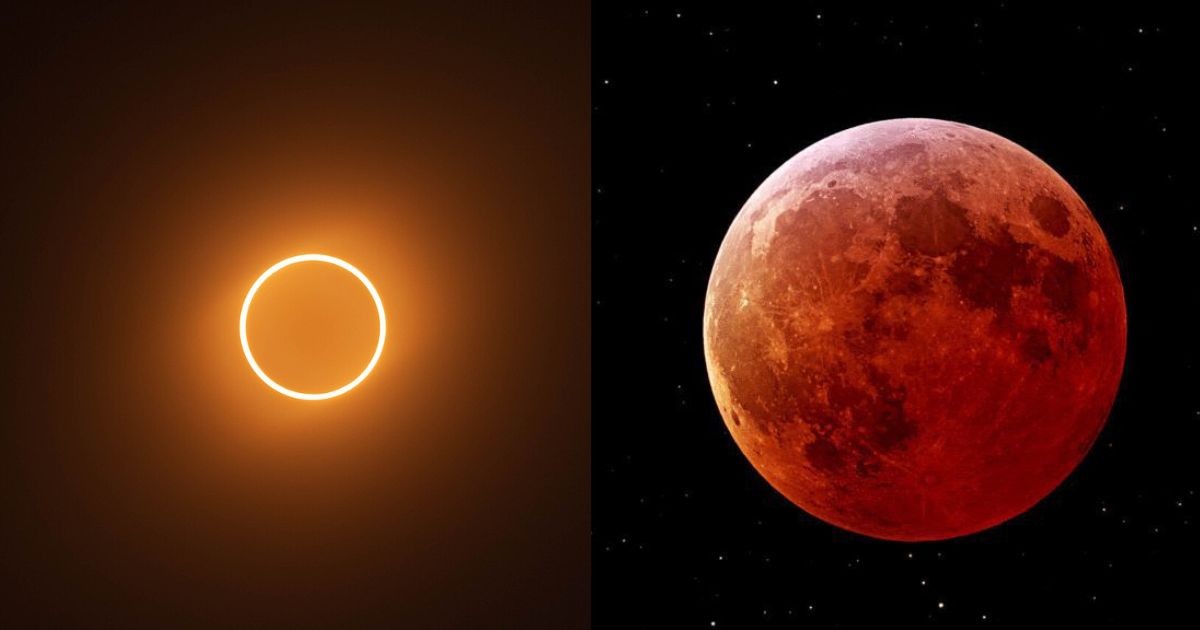
For the first time in over a century, a total solar eclipse crossed northern Spain in mid-August - and less than two weeks later, a striking 96% "blood moon" lunar eclipse will sweep across the Americas on the night of August 27-28. Two major eclipses within one month has stirred a familiar question among many believers: is this a sign?
It's not a new question. Eclipses have prompted spiritual reflection for as long as people have looked up. Genesis 1:14 says God set the sun, moon, and stars "for signs and for seasons, and for days and years" - establishing from the very beginning that the sky was designed with purpose and order, not randomness. Joel 2:30-31 speaks of the sun turning to darkness and the moon to blood before "the great and awesome day of the Lord," language echoed again in Acts 2 and Revelation 6.
Those passages are real, and they're part of why blood moons in particular capture attention in Christian circles. But most Bible teachers caution against reading any single eclipse as a specific, decodable signal. A previous wave of "blood moon prophecy" teaching a decade ago tied a lunar tetrad to a predicted major world event - and when that event didn't come to pass, it became a cautionary example for many pastors about the risks of date-setting or over-interpreting natural phenomena.
What most theologians agree on is simpler: the consistency of eclipses - predictable down to the minute, centuries in advance - is itself a quiet testimony to a universe that runs on order rather than chaos. Whether or not any single eclipse carries deeper significance, the fact that it can be forecast that precisely reflects a creation still operating exactly as it was designed to.
So is August's back-to-back eclipse pair "a sign of the times"? Scripture doesn't hand down a verdict on that for any individual event. What it does offer is an invitation - to look up, take note, and remember that the same God who set the sun and moon in motion is the same one Christians are called to watch for, "at a time you do not expect" (Luke 12:40).
The lunar eclipse peaks at 12:12 a.m. EDT on August 28 and will be visible across North and South America, with partial visibility in Europe and Africa.
Signs of the times or not, one thing remains unchanged: we are called to be faithful and to live each day in the Lord, watching and ready, whatever the sky reveals.
Related Article: Total Solar Eclipse 2026: Exact Times, Where It Will Be Visible, and Why It Won't Reach the U.S.
Related Article: Two Weeks After the Eclipse Over Spain, a 96% "Blood Moon" Is Coming to America: Here's When and Where to See It


