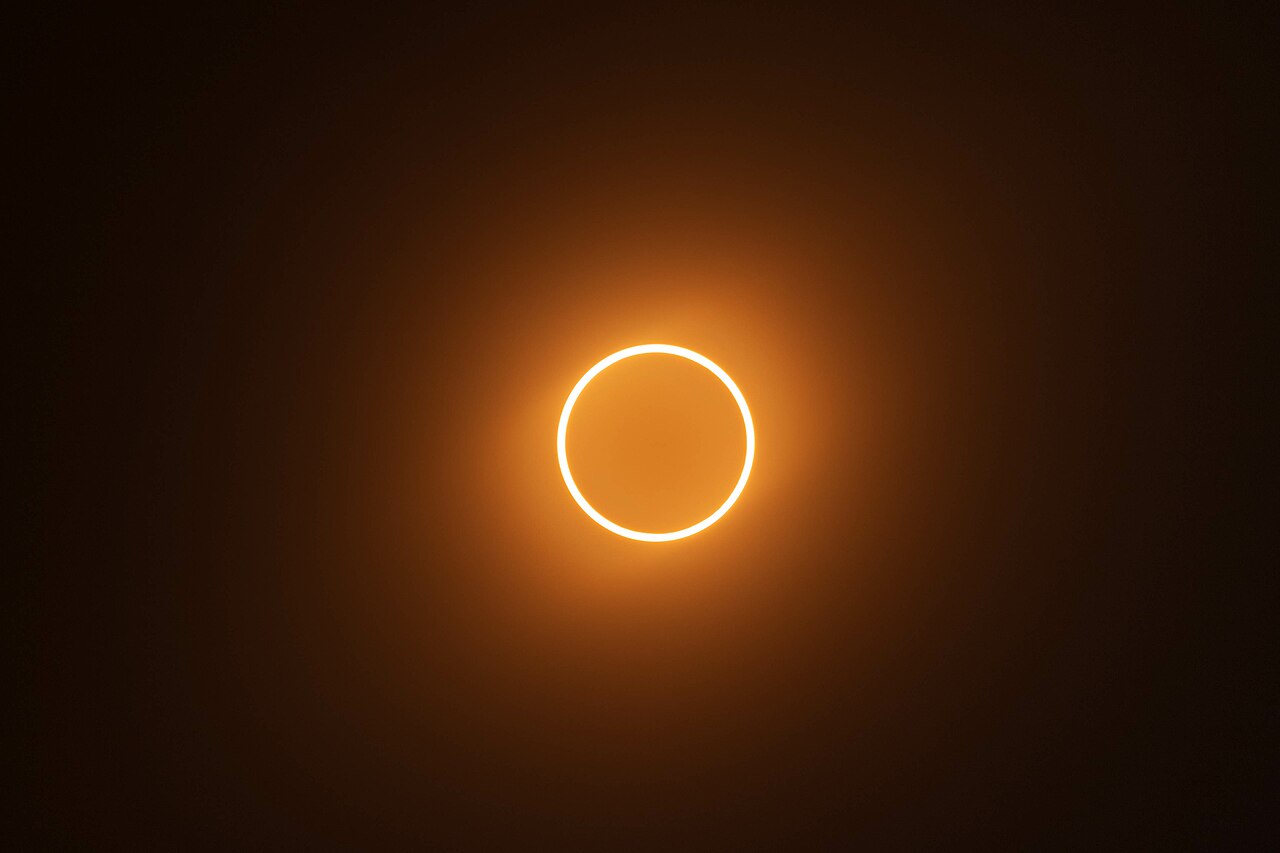
A dramatic "ring of fire" will appear in the sky on February 17, 2026 - but unless you are in one of the most remote regions on Earth, you likely won't see it in person.
The first solar eclipse of 2026 is an annular solar eclipse, a celestial event that creates a glowing ring of sunlight around the Moon. While eclipses occur every year, this one is especially unusual because its most striking phase will be visible to only a tiny fraction of the global population - roughly 2%, according to Time and Date data cited by CNN.
Here's what makes this eclipse special, where it can be seen, and why most of the world will have to rely on livestreams.
What Is a 'Ring of Fire' Eclipse?
An annular solar eclipse happens when the Moon passes directly between the Earth and the Sun, but the Moon is slightly farther away in its orbit. Because of that extra distance, it appears a bit smaller in the sky and cannot fully block the Sun.
Instead of total darkness, observers see a bright ring of sunlight surrounding the Moon's silhouette - the phenomenon known as the "ring of fire."
NASA explains that this differs from a total solar eclipse, where the Sun is completely covered for a brief period. In an annular eclipse, the Sun is never fully obscured, which makes proper eye protection essential throughout the entire event.
When Will the Eclipse Happen?
The eclipse takes place on Tuesday, February 17, 2026.
According to astronomical tracking data referenced by multiple outlets:
-
The first phase begins around 6:42 a.m. ET
-
The most dramatic annular phase occurs later along its narrow path over Antarctica
-
The event lasts approximately two hours in regions within the path of annularity
Exact timing varies by location, and visibility depends entirely on whether you are within the eclipse path.
Where Will It Be Visible?
This is where the eclipse becomes rare.
The full "ring of fire" effect will be visible primarily from parts of Antarctica, including research stations located within the narrow annular path.
A partial solar eclipse - where the Sun appears to have a "bite" taken out of it - may be visible from:
-
Parts of southern Africa
-
Parts of South America
-
Portions of Antarctica
For the vast majority of the world - including North America, Europe, and most of Asia - the eclipse will not be visible at all.
Will the Eclipse Be Visible in India?
No. The February 17, 2026 annular solar eclipse will not be visible in India. While timing conversions may appear in some regional reports, the eclipse path does not pass over the country, meaning there will be no observable solar event in the sky from India.
Why Is This Eclipse So Limited?
Eclipses depend entirely on precise cosmic alignment. As NASA scientists often note, it's all about geometry.
To see the full annular effect, observers must be positioned directly within a narrow corridor where the Moon's shadow passes across Earth. In this case, that corridor stretches across a remote portion of Antarctica.
Because the path is so isolated, many skywatchers worldwide will need to rely on livestream coverage from observatories or research stations.
What Will Observers See?
In areas experiencing a partial eclipse, viewers may notice:
-
The Moon slowly moving across the Sun's surface
-
The Sun appearing crescent-shaped
-
Sharper, more defined shadows on the ground
In the annular zone, observers will witness the defining moment of "annularity" - when the Moon sits centered in front of the Sun, leaving a brilliant ring of light around it.
Even then, daylight does not fully disappear as it would during a total solar eclipse.
How to Watch Safely
It is never safe to look directly at the Sun during an annular or partial solar eclipse without proper protection.
NASA recommends:
-
ISO-certified eclipse glasses (ISO 12312-2 standard)
-
Handheld solar viewers
-
A simple pinhole projector
Regular sunglasses, even very dark ones, are not sufficient.
Because the Sun is never fully covered during an annular eclipse, protective eyewear must be worn at all times when looking directly at it.
What's Next in the Sky?
This annular eclipse marks the start of a new eclipse season. A total lunar eclipse is expected on March 3, 2026, visible across parts of Asia, Australia, the Pacific, and the Americas.
While February's "ring of fire" may be out of reach for most people, the year ahead still offers plenty of celestial events for skywatchers around the globe.
For now, though, a thin circle of fire will briefly glow above Antarctica - a rare alignment of Sun, Moon, and Earth that only a small corner of the world will see firsthand.


