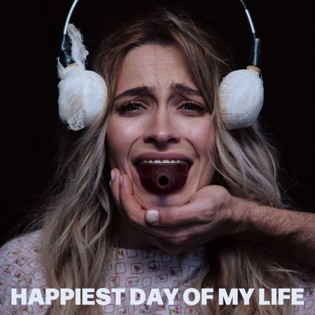
Prime Cuts: "zombies in love," "happiest day of my life," "stitched (on & on)"
Overall Grade: 4/5
Nearly six years after wilted, Paris Jackson returns with Happiest Day of My Life, an 11-song collection that makes one thing clear: Michael Jackson's daughter has little interest in chasing her father's pop legacy.
Instead, Jackson dives deeper into alternative rock. Working with Linda Perry, Butch Walker, and Jason Lader, she surrounds vulnerable songwriting with heavier guitars and '90s-inspired textures. The result feels less polished than lived-in-music about carrying wounds rather than pretending they have disappeared.
Opener "teenage drama" establishes that mood immediately. Despite its title, Jackson treats adolescent baggage as something that follows us into adulthood. "maker" pushes further into questions of identity and the forces that shape us, while the harder-hitting "bang bang" provides an early jolt of aggression.
One of the record's highlights, "zombies in love," finds Jackson exploring romance between damaged people. The "zombies" image suggests lovers carrying emotional deadness of their own, yet Jackson makes the darkness strangely tender. It is an excellent example of her ability to find beauty in uncomfortable places.
At the album's midpoint, "happiest day of my life" complicates its seemingly celebratory title. Coming from someone whose life has unfolded under extraordinary public scrutiny, "happiness" carries considerable baggage. Jackson does not present it as the absence of darkness but something discovered despite it.
Her restrained voice helps. Rather than chasing vocal fireworks, she communicates through breath, weariness, cracks, and occasional bursts of force. That intimacy suits songs that frequently resemble private conversations turned into rock music.
The second half grows increasingly haunted. "sirens," "ghost," and "gaslight" create a vocabulary of warnings, memories, and distorted realities. "ghost" is particularly evocative for an artist whose life has been surrounded by inheritance and absence, while "gaslight" turns inward reflection into a refusal to accept somebody else's version of reality.
Perhaps the album's strongest moment is "stitched (on & on)." Its title captures the record's central idea: healing does not mean becoming untouched again. Something stitched still carries evidence of the wound. The scar proves both injury and survival.
Closing track "american dream" provides an intriguing final statement. Born into one of America's most famous families, Jackson brings unusual weight to that phrase. Fame, privilege, family mythology, public fascination, and private pain inevitably hover around it. After spending an album searching for identity, Jackson leaves us wondering what success means when you were born inside an extreme version of it.
The record occasionally becomes too committed to one emotional register, and Jackson's understated delivery sometimes makes you wish she would unleash more of the power beneath her voice. Yet its consistency is also part of its appeal.
Jackson could have built a career around nostalgia and the Jackson name. Instead, she has chosen distorted guitars, bruised confession, and songs about emotional survival. Happiest Day of My Life begins with "teenage drama" and ends with "american dream"; between them are zombies, sirens, ghosts, gaslighting, and stitches.
And happiness sits right in the middle. Perhaps that is Jackson's point: happiness does not always arrive after the darkness disappears. Sometimes you find it while the ghosts are still there.


