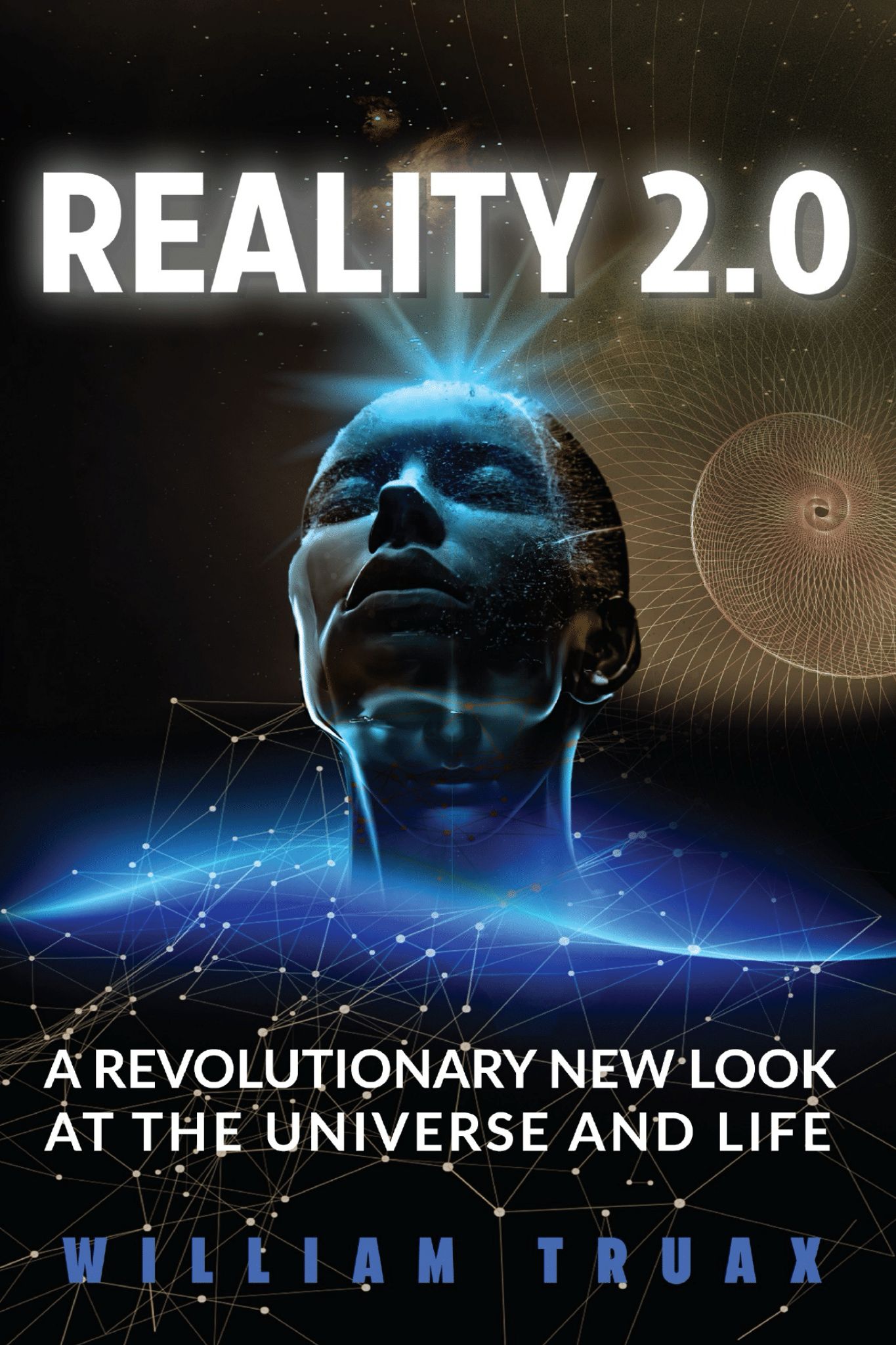
William Truax's book Reality 2.0 has earned major recognition, winning First Place in the Spiritualism category at the International Firebird Book Awards and already reaching #1 international bestseller status in the United States, Canada, and Australia. Published by Blue Ocean Publishing Group, the book introduces Essentia Theory, a "consciousness-first" framework that combines logic, mathematics, philosophy, and modern physics to explore the nature of reality. Through accessible explanations and evidence-based reasoning, Truax argues that consciousness - rather than matter - may be the fundamental basis of the universe, offering readers a new way to think about quantum phenomena, human experience, and the search for meaning.
Watch the official book trailer: https://vimeo.com/1142116279
Q: For readers who are just discovering you, who is William Truax beyond the bio - and how did your journey through music, physics, philosophy, and tax law converge into writing Reality 2.0?
I've always been driven by one question: "Why?" That curiosity led me first into music - I attended conservatory and planned to become a professional musician. But even then, I was studying physics and philosophy alongside my musical training.
After graduation, practicality intervened. I ended up working in the area of tax law, eventually becoming admitted to practice before the U.S. Tax Court - one of a small number of non-attorneys ever admitted. I built a career there. But the curiosity never left.
Years later, I returned to physics - specifically quantum mechanics. The paradoxes bothered me. The standard interpretations felt incomplete. After years of study and logical analysis, I realized that the core issue was our starting assumption about what we are. We think of ourselves as evolved biological accidents. But I came to see that we are fundamentally conscious beings embodied in this universe.
Once that shift became clear, the pieces began to fit - not only in physics, but across human knowledge. That realization eventually became Essentia Theory, and Reality 2.0 is its introduction.
Q: Reality 2.0 has just won First Place in the Firebird Book Awards' Spiritualism category. What does this recognition mean to you, especially as someone positioning Essentia Theory as rigorous rather than mystical?
It's good to get recognition! I don't know that spiritual "ism" is exactly the correct word - maybe something more like spirituality. We live in a really materialistic society, in large part because science has worked well at what it does and been very good to us. It's made us rich beyond the dreams of antiquity.
However, to the degree we've embraced materialism as the fundamental view of life and this universe, we've become a very unhappy and disoriented people. That's because there's lots more to life than just stuff. Essentia Theory puts the focus not on stuff, but on us as living beings, points out that each person needs to work out their own spiritual life, and that religion has historically been the address to these questions.
Q: You challenge materialism head-on and propose Essentia Theory as a "consciousness-first" model. What was the turning point that convinced you matter might not be the fundamental layer of reality?
It was the experimental results which came out of quantum mechanics. When you see things like sub-atomic particles which occupy multiple locations at once, particles which interact with particles which don't even exist yet, particles which are instantly connected with other particles which are half a universe away, particles which don't become real until somebody looks at them, as well as many other things which totally violate common sense, you realize that maybe our existing model of reality isn't quite up to the task.
We have to look outside the box. So, I dusted off the tools of logic and started trying out various explanations which were "outside the box", yet didn't violate or invalidate any experimental data or physical laws, and which stuck as closely to the laws of logic as possible.
As I narrowed down the field, I realized that there was one explanation which really addressed all the problems posed by atomic physics, but also adhered to the laws of logic and reason. And - not only did it address the questions physics has always been unable to answer, it showed me how to organize fields of human knowledge, such as economics, civics and such. It pointed out to me how we could each live our best lives.
Q: Many readers are intrigued by your claim that Essentia Theory can clarify quantum indeterminacy and observer effects without drifting into mysticism. How do you respond to scientists who may be skeptical of a consciousness-first framework?
Science has its limitations. One of the things I write about in the more formal treatment of Essentia Theory is the "mystery horizon". Science has its basic laws, it knows how interactions occur and it can predict how these material things will occur with great precision. But - where did the stuff come from? Why do these laws exist and not others? Why does this universe seem like it was designed for life forms?
These (and many other similar questions) are all things that are outside the ability of science to know about. As one scientist said some years ago, "give us one free miracle and we can explain the rest." Actually, they need more than one miracle, but who's counting?
Anyway, those miracles sit right at the limits of what science can know - they sit on its mystery horizon. Everything beyond that horizon is a mystery for science, and will forever remain a mystery for those fields of knowledge.
Philosophy, in this case, sits outside of, and beyond science. However, it can use the techniques and data of science and logic to approach this area with skill and knowledge, instead of bumbling around with mystic ideas.
What I've done is provide a philosophy, an explanation of how things are that answers more questions - an explanation that moves the mystery horizon back. So - if the scientists are interested in the data, if they want to approach it with reason, we have a framework that is rigorous and that can work for them.
Q: One of the promises of Reality 2.0 is that readers will gain "arguments you can defend to your toughest skeptic." What is one core argument from the book that you believe is especially hard to dismiss?
Probably the double-slit experiment done with one photon at a time. This experiment shows these photons interacting with other photons which are already gone or have yet to come into being. It also shows that, once you have a particle isolated from the rest of the universe, it doesn't have any recognizable reality until there's an observer who looks at it.
If you're limited to strictly materialistic interpretations, these phenomena are puzzling, paradoxical and deeply troubling. In fact, the most widely-followed school of thought in regard to quantum mechanics, the Copenhagen interpretation, says essentially that "you can't understand it, so never mind."
Of course, there's other theories and interpretations which have been put together, such as string theory or "many worlds" theory which each attempt to put these phenomena into an explanatory framework. However, their attempts to do so, while covering some of the bases, all have some loose ends that they can't resolve.
There's a section of the book in Chapter 19, where I go into Essentia Theory and these other interpretations and show what each of the theories does, and does not do. None of them really covers as many bases as Essentia Theory does.
Q: Now that Reality 2.0 has reached international bestseller status and earned major recognition, what's next for you? Are you expanding Essentia Theory further, or exploring new applications of the consciousness-first model?
You bet. I'm expanding it significantly. The book introduces Essentia Theory in an accessible form, but I've completed a much more formal treatment that lays out precise definitions, universal axioms, logical derivations and detailed comparisons to other interpretations.
It's going to be posted soon at my website, www.reality20book.com. This is for readers who want to examine the philosophical foundations of the book rigorously.
But beyond the formal work, I'm developing applications of the theory in areas like economics and civics. The idea is not just to explain quantum mechanics differently, it's to provide a coherent foundation for how we think, organize society and live.
Ultimately, the goal is to give people a clear framework for understanding and achieve happiness and fulfillment - how to live in alignment with reality.
Reality 2.0 is available in paperback and eBook formats on Amazon and major online retailers or www.Reality20Book.com
For additional information and to request a complimentary sample chapter, visit www.Reality20Book.com


